
On forklifts, AGVs, terminal tractors and mining vehicles that run on a DC bus, the traction battery pack, on-board DC-DC converter, DC generator, busbars and wiring harness together form a complete DC power system. These vehicles work under heavy load and start and stop frequently, and the site is often dusty with strong vibration. Once the power system lacks load capacity, busbar voltage sag, overheating terminals and nuisance protection trips follow, directly reducing fleet availability and job safety. The ZENITHSUN DC load bank can be customised in rated voltage, rated current, power and resistance steps to match the customer’s power platform. It replaces the real loads of traction motors, hydraulic pumps and auxiliary equipment on the production line and in service workshops, completing full-load, surge, temperature-rise and protection verification.
1. Why does an engineering vehicle power system need a high-power DC load bank?
Whether an engineering vehicle power system can be trusted comes down to one question: can it carry the load, and can it hold up under it? If only a small dummy load or a bank of lamps is used before the vehicle rolls out, the voltage drop, temperature rise and protection response at full vehicle current cannot be measured, and the problem tends to surface only when the machine works at full load on site.
(1) Battery pack capacity and rate discharge verification: Drawing a constant current up to the platform’s rated current, the test measures the pack’s true usable capacity, continuous discharge capability and terminal-voltage curve, and shows whether voltage sags during heavy climbing or continuous operation.
(2) On-board DC-DC and DC generator load performance: Loading in 25%, 50%, 75% and 100% steps, the test measures voltage regulation accuracy, ripple, efficiency and temperature rise, and checks the dynamic response to load steps.
(3) BMS protection strategy and limit-condition exploration: Simulating overcurrent, undervoltage and sustained high current, it verifies the timing of overcurrent protection, current limiting, alarms and shutdown, so that nuisance trips or missing protection are caught early.
(4) Busbar, harness, contactor and fuse current-carrying and temperature-rise verification: Under sustained high current, the temperature rise and voltage drop of terminals, busbars, harnesses and connectors are measured to expose loose joints and excessive contact resistance.
2. Core advantages of the ZENITHSUN DC load bank
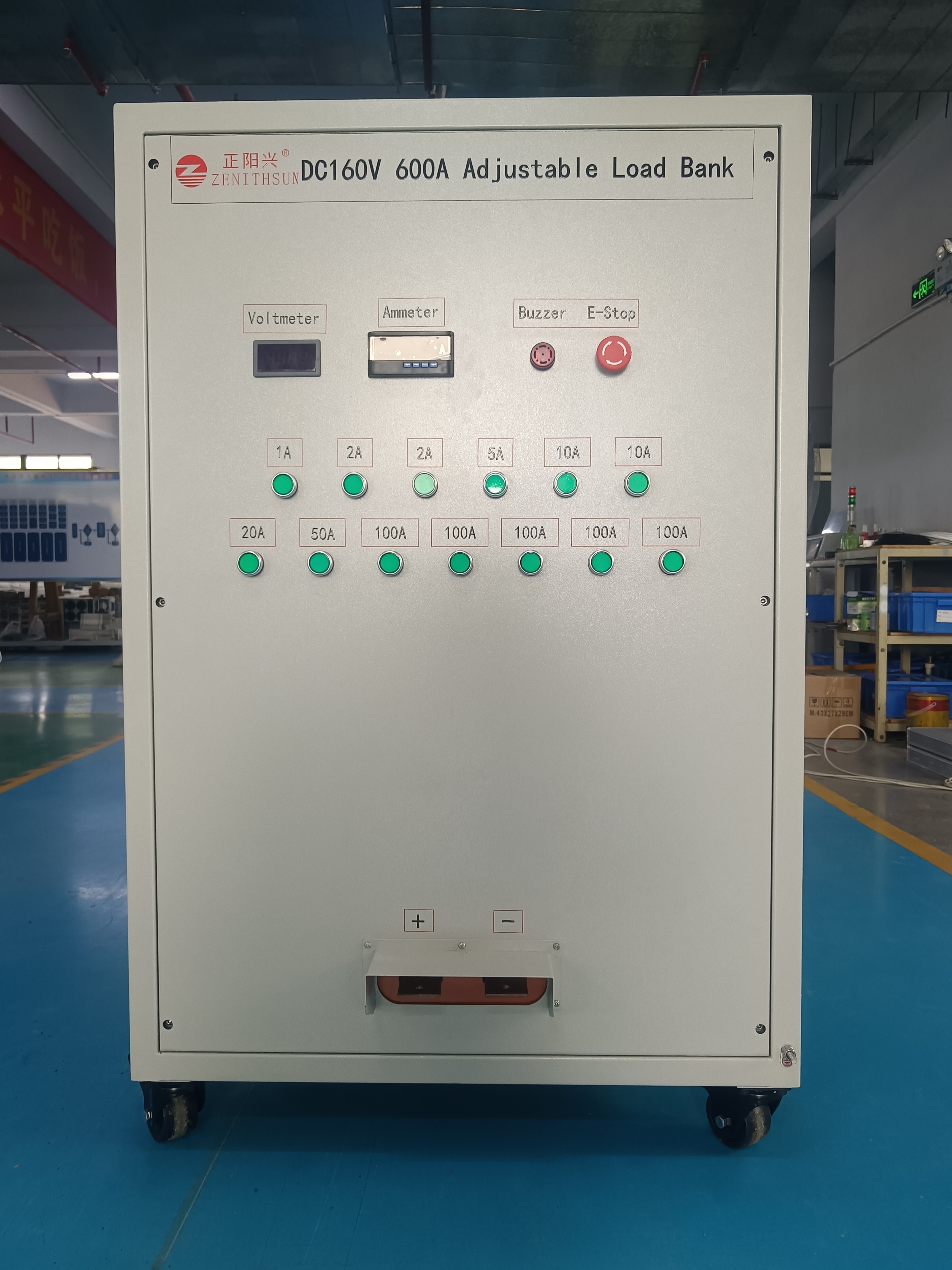
(1) Voltage and current customised to the platform: Rated voltage, rated current, power and resistance steps can all be customised to the customer’s battery platform and test conditions, covering low-voltage DC power systems at different voltage levels. Constant current, constant voltage, constant resistance and constant power modes are supported, with stepped, pulse and continuous full-load profiles.
(2) High-current path and thermal design: Large-section busbars and low-resistance connections are used; terminals, DC breakers and output cables are selected for the customer’s rated current. Forced-air cooling with temperature-controlled fans keeps resistance stable and temperature rise under control during long full-load runs.
(3) Measurement and data logging: Voltage, current, power and run time are logged in real time, and load curves and test data are generated automatically and can be exported directly as process records for factory acceptance and type tests.
(4) Multiple protections: accurate measurement and safe shutdown: Overvoltage, overcurrent, over-temperature, fan interlock, short-circuit and emergency-stop protection are provided. On fault, the load is automatically shed and an alarm is raised, protecting both the load bank and the unit under test.
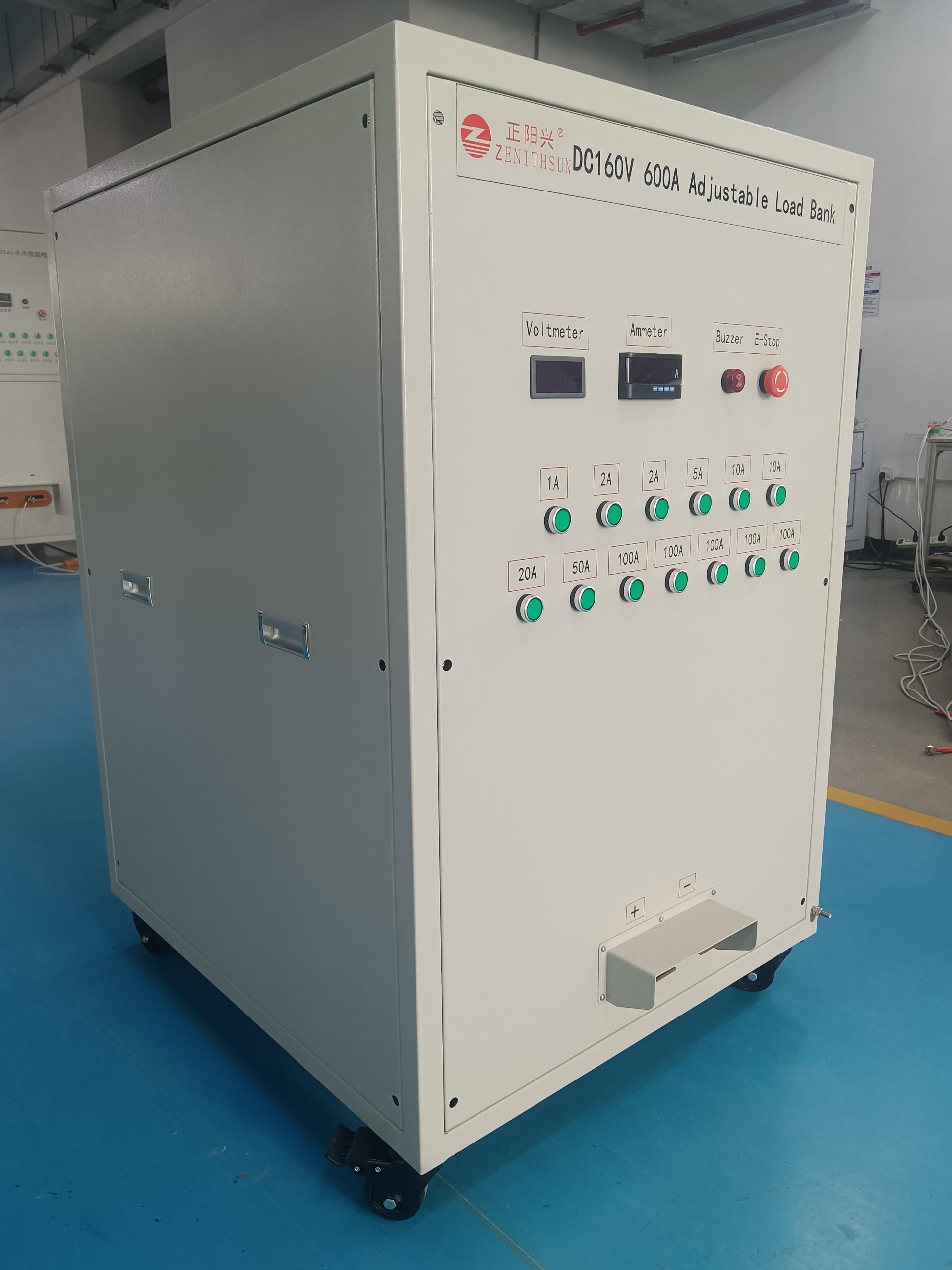
(5) Easy integration into production lines and site work: The floor-standing cabinet on heavy-duty castors moves between workstations. Local operation and remote communication interfaces allow integration into automated test benches, and voltage, current, resistance steps, interface types and cabinet design can be customised.
3. Typical applications on engineering vehicles
(1) Battery pack end-of-line testing and EOL acceptance
Before a pack leaves the line, its capacity, rate discharge and terminal-voltage consistency are checked. The load bank replaces the vehicle load, raising line takt and judgement consistency.
(2) Ageing tests for on-board DC-DC and auxiliary power assemblies
DC-DC converters, pump motor controllers and steering power supplies are aged continuously at full load and high temperature to screen out early failures.
(3) Load acceptance of the complete vehicle power system
After assembly, forklifts, AGVs, terminal tractors and mining trucks are tested without their actuators: the load bank simulates heavy-load conditions to verify busbar voltage drop, protection response and harness temperature rise.
(4) Duty-cycle simulation and strategy calibration in R&D
Loading sequences are set from real vehicle duty curves to reproduce starting, climbing, continuous heavy load and intermittent operation, giving BMS and vehicle energy-management strategies a repeatable test condition.
(5) Service and post-overhaul re-inspection
After a battery pack, main contactor or DC-DC is replaced, a full-load re-test confirms that load capability has been restored and avoids a second repair.
The reliability of an engineering vehicle power system is not about how impressive the nameplate looks. It is about whether the voltage holds, the terminals stay cool and the protection acts correctly at full load. The ZENITHSUN DC load bank brings the heavy-duty cycle from the site into the lab and onto the line, so every power system is genuinely pushed to its limit before the vehicle rolls out. Voltage, current, resistance steps and loading modes can all be customised to the platform, with duty-cycle simulation packages available.
For load bank sizing, duty-cycle simulation and test planning, please contact our technical team.


